
Questions about render and facade insulation
Everything you want to know about render, facade insulation, prices and grants before you start your facade project.
Free and without obligation · reply within 24 hours
Render
What is render (crepi)?
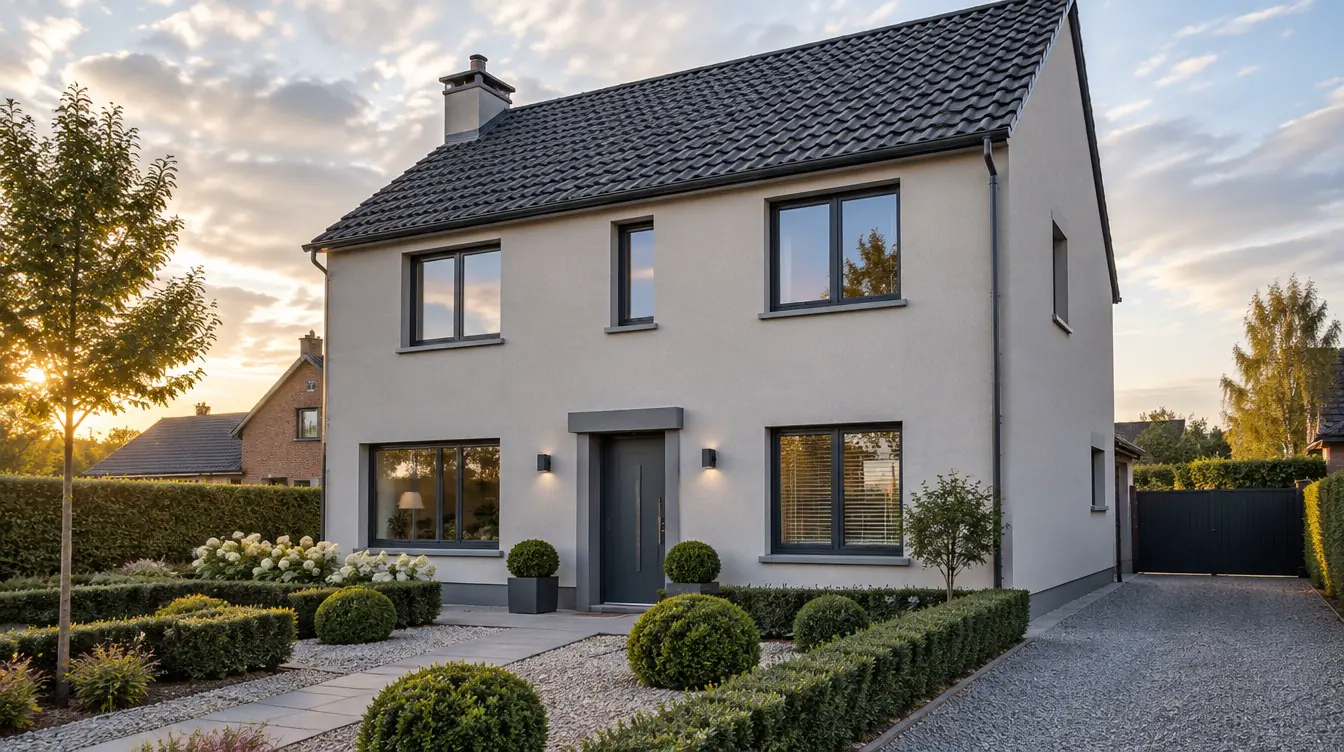
Crepi is the popular Belgian name for facade render: a thin decorative render that forms the last, visible layer of the facade. Presheva Group mainly works with silicone resin renders from Caparol and Relux: water-repellent, dirt-repellent and vapour-open. Render can go directly on a sound facade, but usually goes on external wall insulation. More explanation and the build-up layer by layer are on our render page.
How much does render cost per m² in 2026?
At Presheva Group render costs from €90 per m² without insulation and from €110 per m² with 10 cm of grey graphite EPS, excl. VAT. For the renovation of a home older than 10 years you usually pay 6% VAT. With the price calculator you get an immediate estimate for your facade; after a free site visit you receive a fixed price: quote = invoice.
Can render be applied to an existing brick facade?
Yes. Render can go on an existing facade in brick, block, concrete or old plaster, as long as the substrate is stable and dry. We first repair cracks and loose parts, apply a reinforced base coat with glass-fibre mesh and then finish with render. We usually advise insulating at the same time: the scaffolding and preparation then pay off twice.
How long does a rendered facade last?
A professionally applied rendered facade with a certified system lasts for decades with little maintenance. Presheva Group gives a 12 to 15-year guarantee on the facade work carried out. Check the facade once a year and clean it gently; more tips in how do you maintain a rendered facade?
Does render crack or turn green?
Cracks mainly appear when the substrate moves or when work is done without reinforcement. We always apply render on a reinforced base coat with glass-fibre mesh, following Caparol's specifications, so the facade stays crack-free. Green growth appears in places that stay damp for a long time, such as a north facade under trees. The silicone resin renders we use are water-repellent, which greatly limits growth.
Which colours and grain sizes are available for render?
You choose from the full Caparol colour range, from white and grey to warm and bold shades. The most popular grain size is 1.5 mm; a finer grain gives a crisp, modern look, a coarser grain hides irregularities better. With our colour tool you see in advance what your own home will look like, and during the site visit we show real samples.
What is the difference between render and sprayed cork?
Render is a decorative plaster applied with a trowel, giving a crisp, mineral look. Sprayed cork is a sprayed layer of cork granules with a softer texture. Presheva Group works with render on certified systems from Caparol and Relux. The full difference is explained in render or sprayed cork.
Do I need a permit for render?
Re-rendering a facade in a similar colour is usually exempt. If the look of the street facade changes significantly, the insulation extends beyond the building line or plot boundary, or your home is listed heritage, a notification or planning permit may be required. The rules differ per municipality: we check this during the site visit and help you with the application.
Facade insulation
What is external wall insulation?
With external wall insulation, the insulation goes on the outside of your wall: insulation boards are bonded and anchored, then finished with a reinforced base coat and a finish such as render, stone look or brick slips. This creates a continuous warm coat around the home, without thermal bridges and without losing indoor space. Everything about the system is on our page facade insulation.
What does working according to the ETICS guidelines mean?
ETICS stands for External Thermal Insulation Composite System: an external wall insulation system in which the insulation boards, adhesive, any anchors, reinforcement and finish are tested and approved as a whole. In Belgium, Buildwise's Technical Information Note TV 257 (Buildwise was formerly WTCB/CSTC) describes how such a system must be designed and installed. Presheva Group works according to these ETICS guidelines and the instructions of Caparol's certified Capatect system, so every layer and every junction is carried out correctly.
Which facade insulation do you use?
We work according to the ETICS guidelines with Caparol's certified Capatect external wall insulation system, using grey graphite EPS boards: they insulate better than traditional white EPS at the same thickness. The boards are bonded and anchored, with a reinforced base coat with glass-fibre mesh and a finish of your choice, such as render, stone look or Meldorfer brick slips. We match the type and thickness of insulation to your home and the grant conditions.
Why do you use grey EPS rather than white?
Grey EPS contains graphite, which blocks heat radiation. Grey graphite EPS (lambda about 0.031 W/mK) therefore insulates clearly better than white EPS (0.035 to 0.038 W/mK). You reach the same insulation value with a thinner board, or better insulation with the same thickness. That is why Presheva Group always uses grey graphite EPS.
How thick should facade insulation be?
With grey graphite EPS, 10 cm achieves an Rd value of about 3.2 m²K/W, enough for the grant requirement of Rd 3. Thicker insulation pays off: 14 cm gives about Rd 4.5 and 18 cm about Rd 5.8. Each extra centimetre costs about €2 per m². More in how thick should facade insulation be?
How much do I save with facade insulation?
A home often loses a quarter of its heat through an uninsulated external wall. With 10 to 14 cm of grey graphite EPS, heat loss through that wall drops by 80 to 90%. How much that saves in euros depends on your home, your heating and energy prices. You also gain comfort: no more cold walls, fewer draughts and less risk of condensation.
Is external insulation better than internal insulation?
Usually, yes. Insulating on the outside means no loss of indoor space, no thermal bridges at floors and internal walls, and you can keep living at home during the work. The facade also gets a new finish straight away. Internal insulation is mainly an option when the outside may not change, as with listed heritage. More in insulating a facade: inside or outside?
Does facade insulation improve my EPC label?
Yes. Facade insulation is one of the measures with the biggest impact on a home's EPC label, especially if the walls are currently uninsulated. That matters for resale value and for the Flemish renovation obligation: anyone who has bought a home with label E or F since 2023 must bring it to at least label D within five years.
Can my wall still breathe after facade insulation?
Yes. The system we install is vapour-open: moisture in the wall can escape, while rain stays out thanks to the water-repellent finish. Because the wall stays warm, the risk of condensation and mould on the inside also drops.
Is facade insulation possible on every home?
On most homes, yes: detached, semi-detached or terraced, with a facade in brick, block, concrete or old render. Points of attention are the roof edge, window sills, the building line on the street side and the boundary with the neighbours. During the free site visit we look at what is possible for your home and which thickness suits it best.
Price, grants and financing
How much does facade insulation cost per m²?
At Presheva Group, facade insulation with 10 cm of grey graphite EPS and a finish costs from €110 per m² with render, from €150 with concrete look, from €165 with stone look and from €210 with Meldorfer brick slips, excl. VAT. Each extra centimetre of insulation costs about €2 per m². A full overview is in what does facade insulation cost per m²?
How much does a facade renovation or render cost?
The price depends on the surface area, the condition of the substrate, the chosen finish and whether insulation is added. That is why we always visit first, free of charge. You receive a detailed quote with a fixed price: what is in the quote is what you pay on the invoice.
Which VAT rate do I pay for render and facade insulation?
For the renovation of a home older than 10 years, the reduced VAT rate of 6% usually applies in Belgium. For new builds you pay 21% VAT. In our price calculator you choose renovation or new build, so the price incl. VAT is right straight away.
Can I get a grant for facade insulation?
Since 1 March 2026, Mijn VerbouwPremie in Flanders only grants a premium for external wall insulation to owner-occupiers in income categories 3 and 4 (the lowest incomes) and to those who rent out through a social housing company. The new insulation on the outside must reach an Rd value of at least 3 m²K/W: 10 cm of grey graphite EPS (lambda 0.031 W/mK) gives about 3.2 m²K/W. We calculate what you are entitled to, handle the application together with you and provide all invoices and certificates. We also help you with financing, for example with Mijn VerbouwLening. For homes older than 10 years, the reduced VAT rate of 6% usually applies as well.
How can I finance my facade insulation?
With Mijn VerbouwLening from the Flemish government you can borrow for energy-efficient renovations, such as facade insulation, at a low interest rate, for some households even at 0%. We provide the quote and invoices you need for the application. More on our page financing.
Is scaffolding included in the quote?
Presheva Group has its own scaffolding and erects it itself. The cost is clearly stated in your quote.
How does payment work?
We ask for a deposit at the start of the works. The amount depends on the project: your adviser explains it clearly when preparing the quote, and all payment terms are set out in writing in the quote. You pay nothing beyond what was agreed.
Practical matters and how we work
Which brands and products does Presheva Group work with?
For facades we work exclusively with the premium brands Caparol and Relux: certified facade systems, plasters, paints and primers with the necessary technical approvals. For facade cladding we use Trespa, for interior plastering Knauf, and for roofing Wienerberger Koramic tiles and Velux roof windows. We use only these products, purchased through our approved partners and distributors Defrancq and Vandeweege.
Is a site visit needed for a quote?
Yes. Every facade is different. During a free site visit we look at the substrate, the junctions and access, so the quote is correct and you get no surprises afterwards.
What happens in bad weather?
Render and plaster need dry weather and suitable temperatures to cure properly. In rain or frost we postpone the works. You are always informed in time about an adjusted schedule.
Does Presheva Group work with subcontractors?
No. Presheva Group works exclusively with its own staff: permanent crews of more than 50 craftsmen whom we train and supervise ourselves. From the scaffolding to the final finish, everything is done by our own people, led by one dedicated project manager. So you always know who is working on your site.
Which region does Presheva Group work in?
We are based in Oudenaarde (East Flanders) and work throughout Flanders, with most projects in East and West Flanders, such as Oudenaarde, Zottegem, Ghent, Aalst, Lokeren, Kortrijk and Wevelgem. We have also carried out projects just across the border in Zeelandic Flanders (the Netherlands). We do not work in Brussels or Wallonia.
What warranty do you give?
Presheva Group gives a 12 to 15 year warranty on completed facade works, depending on the system and finish. That is 2 to 5 years longer than legally required: in Belgium contractors are subject to a ten-year liability. Because we only work with certified premium brands and install everything to specification, we can offer this extra peace of mind. The warranty covers all completed works and you receive it in writing.
Do I need to prepare anything before the works start?
Make sure the facade is freely accessible: move planters, garden furniture and cars near the facade. We protect windows, doors, sills and the surroundings ourselves before we start.
Are my surroundings protected during the works?
Yes. Windows, doors, patio, driveway and plants are covered with sheeting and protective material. After the works we leave a clean site.
Do you work with architects and clients?
Certainly. Besides homeowners, we work for architects, contractors and developers, in new builds and renovations, on residential, commercial and industrial projects.
What if additional problems with the facade come up during the works?
If we discover hidden damage, such as cracks or damp problems, we stop first and discuss it with you. Additional works are only carried out after your approval, at a clear price.
How soon can you start?
We usually start within two months of the quote being signed. We agree the exact start date with you, taking the weather and planning into account.
Do you also take on small jobs?
Yes. You can also call on Presheva Group for a single facade, a repair or a small area of render. We are happy to come and take a look and draw up a clear quote.
Is Presheva Group insured?
Yes. Presheva Group is insured for civil liability and for the contractor's ten-year liability.
What roofing work do you do?
Everything to do with roofing: a new pitched or flat roof, roof insulation, replacing an asbestos roof, leak repairs, roof windows, gutters and zinc work. We do not install solar panels. If you combine roof and facade, our own crews do it all in one planning.
Is my facade repaired first?
Yes. We first repair cracks, damage or damp patches in the substrate, so that the insulation and the new finish are applied to a sound surface. We assess what is needed during the free site visit.
Can I come and see samples at your premises?
Yes, you are welcome at our premises at Paalstraat 1A in Oudenaarde during office hours. Feel free to let us know in advance when you are coming. Prefer to choose at home? Then your adviser will bring the samples.
Do you have your own warehouse?
Yes. Presheva Group has its own 1,300 m² warehouse with all materials in stock. That way we do not depend on delivery times or rising market prices: we can start quickly and your price stays as stated in the quote.
How does the free site visit work?
A personal Presheva Group adviser visits you, looks at your facade or roof and discusses your wishes. The adviser brings samples of all finishes and colours. A visit is also possible in the evening or on Saturday.
Do you arrange parking restrictions and scaffolding at the neighbours'?
Yes. If a parking restriction is needed, we arrange it. If the scaffolding has to stand (partly) on the neighbours' property, we ask for their permission first.
Do you also install windows and sills?
Sills, yes: with facade insulation we fit new window sills in aluminium or bluestone. We do not install new windows ourselves; if your windows are being replaced, we coordinate the planning with your joiner.
In which languages can I be helped?
At Presheva Group you can be helped in Dutch, French and English.
What happens after handover?
After handover we go through all the points together with you. That way you can be sure everything is in order, and if you still have a question you can always contact your dedicated contact person.
Can I do part of the work myself?
Yes, you can. Discuss it with your adviser when the quote is being prepared, and we will take it into account. Note: for Mijn VerbouwPremie and Mijn VerbouwLening, insulation work must be carried out by a contractor.
How long does a facade renovation with render or insulation take?
At Presheva Group, a facade renovation takes about 6 working days. It does depend on the weather, the chosen finish, the size of the facade and other factors such as accessibility and the condition of the substrate. With the quote you get a realistic schedule, and your project manager keeps you informed during the works.
“Literally from old to new once Presheva has worked on your house. In a word: beautiful.”
Question not listed? Call us on +32 9 496 02 76 or send us a message. You will find more background in our knowledge base.
Ready for a facade you will enjoy for years?
Request a free site visit. You get tailored advice and a fixed-price quote, with no surprises.